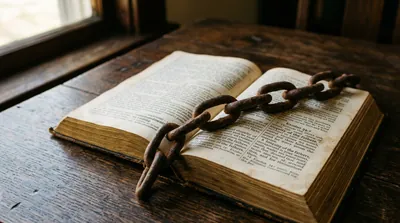
I do not call it karma. I do not call it by the words the wellness industry has invented to flatten what scripture already named. I call it what scripture calls it, what my grandmother called it, what every Mexican-American grandmother I ever knew called it: la cadena. The chain. The chain is what is passed forward when something in the bloodline is not faced — when grief is buried, injustice is swallowed, a wound is closed before it could heal.
Different traditions name it differently. Some Christians call it a generational curse. Some say bloodline curse or family curse. Older Catholic communities, like the one my grandmother served in McAllen, simply called it la herencia — the inheritance. Pentecostal and deliverance traditions speak of ancestral curse or inherited curse. These are the same chain, named in different vocabularies. The King James Bible uses the oldest name of all: the iniquity of the fathers.
What the Bible says
Most modern Christians have heard generational sin discussed once, then never again. The verses are quiet, but they are not few:
"I the Lord thy God am a jealous God, visiting the iniquity of the fathers upon the children unto the third and fourth generation of them that hate me." Exodus 20:5 · KJV
"The Lord, The Lord God, merciful and gracious, longsuffering, and abundant in goodness and truth... visiting the iniquity of the fathers upon the children, and upon the children's children, unto the third and to the fourth generation." Exodus 34:6–7 · KJV
"...visiting the iniquity of the fathers upon the children unto the third and fourth generation of them that hate me." Deuteronomy 5:9 · KJV
"The Lord is longsuffering, and of great mercy... visiting the iniquity of the fathers upon the children unto the third and fourth generation." Numbers 14:18 · KJV
"Our fathers have sinned, and are not; and we have borne their iniquities." Lamentations 5:7 · KJV
Five times. Four authors. Four different historical contexts. The same testimony. Whatever the chain is, the Bible is in no doubt that it is real.

How the chain behaves
The chain behaves like a thing that wants to live. It is not, my grandmother believed, an abstract pattern. It is something with a kind of cunning.
- It feeds on pain. Every disappointment in the family makes the chain stronger. The grief that gets swallowed becomes the chain's next meal.
- It hides in plain language. It calls itself bad luck, destiny, just the way the family is. It puts its disguise on so well that most descendants never look directly at it.
- It keeps you busy. The chain prefers descendants who are exhausted, distracted, overworked, in survival. A soul that has time to sit and reflect is a soul that begins to see. The chain does not want to be seen.
- It speaks in your inner voice. When someone tells you about the chain, the chain itself answers from inside you: "that doesn't apply to my family", "that's superstition", "my grandfather did the best he could". Notice how strong that voice is. That is the chain protecting itself.
The seven most common signs
I have read for thousands of souls. Across the readings, certain signs of the chain appear so often that I now recognize them on first sight. If three or more of these are true in your family across two or more generations, the chain is almost certainly walking — and it is almost certainly walking into you.
- The same kind of marriage breaks down repeatedly. Mother divorced. Daughter divorced. Granddaughter on her second marriage. Or: the men in the family abandon. Or: the women in the family marry a man who drinks. The pattern repeats with different faces.
- Money disappears. It comes in. Something happens. It is gone. Inheritance evaporates. Bonuses vanish on emergencies. Three generations of "almost made it" stories.
- The same illness returns generation after generation. Not just hereditary diseases — though those count. The same kind of breakdown, the same age of mysterious fatigue, the same unexplained chronic thing.
- Addiction or vice walks the bloodline. Grandfather drank. Father drank. The son swears he never will. The grandson is twenty and you are watching it again.
- A particular shame or secrecy is unspoken in the family. There is a story no one tells. There is a relative no one mentions. There is a year on the family timeline that everyone goes around.
- You have prayed faithfully, worked hard, tried therapy, gone to retreats — and one chamber is still sealed. You are not lazy. You are not lacking faith. You are not unloved by God. Something is pulling backwards that no individual effort has been able to release.
- You feel something is wrong that no one in the family will name. You may be the first descendant in three generations who is willing to look at it. That is not coincidence. That is why you are here.
What the chain is not
I want to be careful, because there are misunderstandings here that hurt people.
- The chain is not God punishing you for someone else's sin. That is not the gospel. God is just; the cross was complete. What the verses describe is consequence — what gets passed down because the bloodline did not face it — not divine vengeance.
- The chain is not your fault. You did not put it there. You inherited it. The grief is real, but the guilt is not yours.
- The chain is not stronger than Christ. Galatians 3:13 names the redemption clearly: "Christ hath redeemed us from the curse of the law, being made a curse for us." The work is to step into that redemption consciously, not to repeat by inertia what was given freely.
- The chain is not "your destiny." That is the chain disguising itself. There is no soul without a way out.
Christian teachers who have written on the chain
I am not the first Christian to name this. Faithful pastors and teachers have written entire books that I have read and respect:
- Derek Prince · Blessing or Curse: You Can Choose · arguably the most-read book on this subject in the English-speaking world · over 1.6 million readers · translated into more than 100 languages.
- Larry Huch · Free Yourself From the Spirit of Generational Curses · the gold standard in the Word of Faith tradition.
- Marilyn Hickey · Breaking Generational Curses: Releasing God's Power in Us, Our Children, and Our Destiny · widely read in mainstream Pentecostal and Charismatic circles.
- John Eckhardt · Generational Curses · part of his larger body of work on deliverance and prayer in the Apostolic tradition.
I do not ask you to take my word for it. I ask you to take theirs and mine together. I ask you to take the King James Bible's word for it. The chain is not a private teaching. It is two thousand years of the church wrestling with the same scripture.
The way out
The way out, in three steps, is no different from what these teachers have written — I name them in my own words because that is how my grandmother taught me to speak.
- See it. Until you can name what walked through the family before you, the chain will keep walking through you wearing your own face. This is what the reading is for.
- Refuse to feed it. The chain feeds on whoever does not see it. The moment you see, you can begin to refuse. This is also what scripture is for. Repentance — not for what you did but for what your bloodline did and what you have been carrying forward without consent — is the door.
- Seal the chambers from inside. Praying for the door to close from outside is exhausting. Sealing the chamber from inside is durable. This is the work that some — not all — souls who come for a reading are eventually drawn to. There is a method. I will speak of it elsewhere.
"What you carry was never yours.
The chain ends here."
If you feel called to see what your three gates reveal, the reading is here for you.
"The chain ends here."
Walk to the Reading →