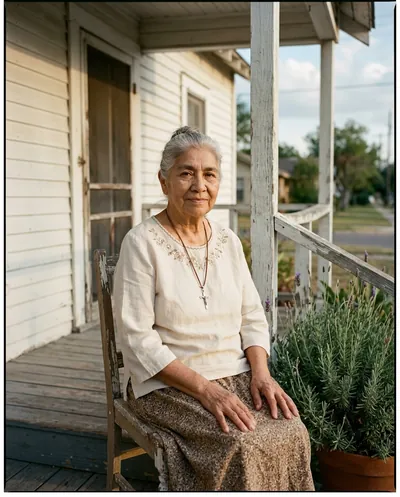
"Mi abuela no sabía leer en inglés.
Pero leía almas en tres lenguas."
My grandmother could not read in English.
But she read souls in three languages.
Who she was
Esperanza Beatrice de la Cruz was born in 1908 in Saltillo, Coahuila — a city in northern Mexico. Her family crossed the Rio Grande into Texas in 1928 when she was twenty. They settled in the Rio Grande Valley, in McAllen, where the Bible Belt meets the Hispanic Catholic South. She would live in McAllen for the next fifty-seven years, in the same small wooden house with the porch that creaked, the lavender garden, and the kitchen that always smelled like melted candle wax and cinnamon.
By trade, she was a seamstress. She mended vestments and altar linens for Sacred Heart of Mary parish. She also took on private work — wedding dresses, christening gowns, mourning veils. Her hands were quick and her stitches were impossibly fine.
She was also la curandera. The neighborhood went to her door before they went to the doctor — for fevers in babies, for heartbreak in young women, for fights in marriages, for the inexplicable sadness that fell on certain families generation after generation. She did not advertise. She did not charge. People brought what they could — beans, eggs, a folded dollar bill, a few wildflowers. She accepted everything and turned no one away.
What she carried
She was a devout Catholic. She prayed the rosary every morning. She went to mass twice a week and to confession every fortnight. She believed in the saints, in the angels Michael, Gabriel, and Raphael, and in Christ as Lord. None of this was performance — it was the air she breathed.
And she also read cards. To the modern American reader this seems like a contradiction. To the Mexican-American Catholic woman of her generation it was nothing of the kind. The same hand that lit a votive candle could also lay down the Rider-Waite deck on a clean linen cloth. The same eyes that read Lamentations could also see what was sealed in the chamber of love. She held the two practices in the same body the way a river holds two currents.
She would have rejected — gently but firmly — any attempt to call her a witch. She would have laughed at the word psychic. She used the words she was given: curandera. Lectora. Sierva del Señor. Servant of the Lord. That was enough.
Her objects
A few things from her life still travel with me today.
The deck
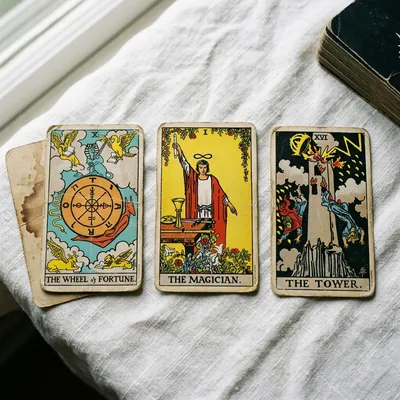
A 1971 Rider-Waite deck. The corners are worn soft. There is a tea-stain on the back of the Six of Cups. The Wheel of Fortune has a crease across the center — she used to mark the cards she was teaching me to recognize. She gave me the deck the night before she died.
The Bible
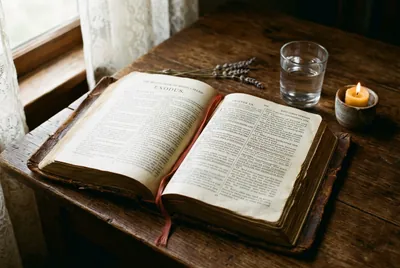
A King James Version. Brown leather cover, worn pale at the spine. Five verses underlined in pencil — the verses that name the chain. Exodus 20:5. Exodus 34:7. Deuteronomy 5:9. Numbers 14:18. Lamentations 5:7. Two red ribbon markers, one in Exodus, one in Lamentations. She had marked them long before I was born.
The letter
A handwritten letter she left for me in 1985, on the dresser in her bedroom. Two hundred and eighty-seven words. The opening:
"Mi nieto. Cuando leas esto yo ya estaré. Pero esta carta no es despedida — es transmisión..." — Esperanza · 1985
My grandson. When you read this I will already be gone. But this letter is not a farewell — it is a transmission. (The full letter remains private. One day I may share more.)
The leather crucifix
A small silver cross on a leather cord. She wore it her whole adult life. I wear it now, every day, including when I read.
The blue shawl
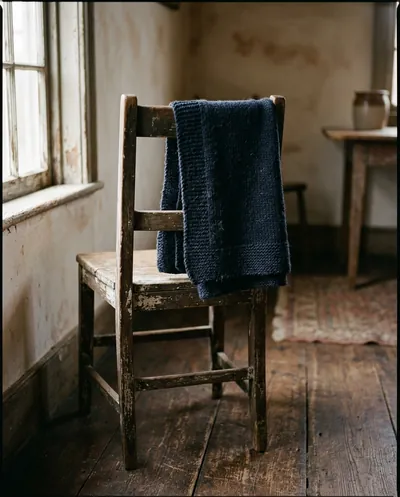
A dark navy wool shawl she draped over her shoulders when she sat down to read. I keep it folded. In private sessions, I sometimes lay it across the table.
How I knew her
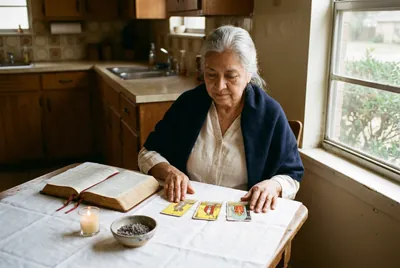
I was twelve in 1976 when she sat me down on the porch for the first time. I had told her something — a thing I had felt for years and never named. She listened, hands still on her lap, and said:
"Niño,
this is not yours.
This came before you."
Those were the first words. She repeated them many times in the seven years she had left. She would say them in Spanish, in English, sometimes in the broken Tex-Mex that lived in her kitchen. Always the same three sentences. Always the same finger pointing at the chain that no one else in the family seemed to see.
At fifteen I sat at her side while she read for Doña Rosa, a neighbor whose teenage son had been taken in by the wrong crowd. I watched the cards. I watched her face. I watched Doña Rosa's face when the words landed. And for the first time I understood: this is not parlor-trick. This is not guesswork. This is a particular kind of seeing — and it was being placed in my hands.
At twenty-one I was at her bedside the week the cancer took her body. The night before she crossed, she asked me to bring the deck and the Bible to her. She placed both in my hands. She closed her eyes and said:
"Ahora la cadena pasa por ti. Tú decides si la rompes o si la pasas." — last transmission · 1985
Now the chain passes through you. You decide whether to break it or to let it walk.
Where she rests
Esperanza is buried at the Catholic Cemetery in Mission, Texas, twenty minutes from McAllen. Her grave is simple — a small headstone with her name, her dates, and a cross. There is room next to her, reserved, for those of us in the family who will follow her one day.
I visit once a year, in October, near the day she died. I bring lavender from her garden — which my mother kept alive, and my sister kept alive after her, and which my niece now tends. I sit beside the headstone for an hour. I do not read cards there. I do not pray out loud. I just listen.
The name
Esperanza, in Spanish, means hope. She used to say:
"Esperanza is what I gave you
because esperanza is what we don't inherit.
Esperanza is what we plant."
She did not give me her name. But she gave me what her name meant. That, I am still learning to plant — one reading at a time.
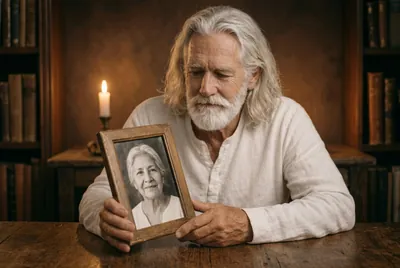
"My grandmother taught me.
What you carry was never yours.
The chain ends here."
What my grandmother taught me, I now offer. The Three-Gate Reading is open.
"The chain ends here."
Receive the reading →