May 20, 2026
The Limpia (Spiritual Cleansing): What It Really Is
A limpia is the spiritual cleansing of the curandera tradition. What it is, where the line falls between Catholic faith and superstition, and what my grandmother would say about it. By Celestino.
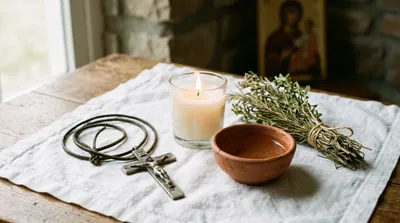
If you grew up anywhere near the Mexican-American world, you have probably heard the word — limpia — and maybe you have had one done, by a grandmother or a tía, perhaps without quite knowing what it was. Let me tell you what a limpia really is, and then tell you the most important thing about it, which is where the line falls between faith and superstition. Because my grandmother did limpias, and she also drew that line more sharply than anyone I have ever known.
What a limpia is
Limpia means, simply, a cleansing. In the curandera tradition it is a spiritual cleansing — a prayer ritual meant to clear away what the old people called mal de ojo (the evil eye), heaviness, fear, or spiritual disturbance. The forms vary by region and family: sometimes prayer over a person with herbs like ruda or romero (rue or rosemary), sometimes the passing of an egg or a candle, always — in the faithful version — wrapped in prayer to God and the invoking of the saints as intercessors.
At its heart, a limpia is a way of saying, with the body and not just the mind: Lord, take this off of me. I cannot carry it.
The line my grandmother drew
Here is the thing I most want you to hear, because it is the thing the internet will not tell you. My grandmother, Esperanza — a curandera and a devout Catholic — believed completely that the cleansing came from God, never from the egg, the herb, or the candle.
The moment a person believed the object held power — that the egg itself pulled out evil, that the herb itself protected — she stopped them. “Eso es superstición,” she would say. That is superstition. The egg is just an egg. The herb is just an herb. The prayer is the thing, and the One the prayer rises to is the only one who cleanses. Take that away and a limpia is just folklore, or worse, a door to the very thing it claims to remove.
This is the exact same line I draw in everything I do — in prayers of protection, in what I teach about guardian angels. We never trust the ritual. We trust God. The form is only the asking.
Where Scripture meets the tradition
The longing behind a limpia is deeply biblical. “Purge me with hyssop, and I shall be clean: wash me, and I shall be whiter than snow” (Psalm 51:7). “Create in me a clean heart, O God” (Psalm 51:10). The instinct that we carry things we cannot remove ourselves — and must bring to God to be washed — is not pagan. It is the oldest cry of the faithful. The danger is never the longing. The danger is trusting the wrong thing to answer it.
What I carry forward — and what I don’t
I will be honest about my own work. I am not selling you a limpia. The gift in my lineage settled, in me, not into the egg and the herb but into the seeing — the discernment of what is actually weighing on a soul and a family, and the bringing of it before God. What my grandmother did to clear a heaviness, I do by naming the chain: finding the inherited pattern that has settled over a life, so it can be confessed and broken through Christ rather than merely brushed off the surface.
Because here is the limit of any limpia, however faithful: it can lift what is on you. It cannot, by itself, reach what was handed down to you — the pattern rooted three generations back. For that, the heaviness has to be seen all the way to its root and broken at the source.
“What you carry was never yours. The chain ends here.”
That deeper cleansing — the naming and breaking of what your bloodline handed you — is the work of the Three-Gate Reading. It is the same old longing my grandmother answered with prayer and hyssop: Lord, take this off of me. Only now we follow it all the way down to where it began.