May 5, 2026
Esperanza Beatrice de la Cruz · The Woman Who Started It All
She was a Mexican-American Catholic curandera in McAllen, Texas. She read souls in three languages. She was my grandmother — and she is the reason every reading I do today still begins the way she taught me to begin it.
I do not write often about my grandmother because I am not sure how to do it well. She was the kind of woman whose entire life is a reproof to the way we are taught to write biographies. Nothing in her seventy-seven years would compress neatly into the press release she would have refused to give. So I will not try. I will only put down, in the order they come to me, the things I want to be remembered.
Her name was Esperanza Beatrice de la Cruz. She was born in Saltillo, Coahuila, Mexico, in October 1908. Her family crossed the Rio Grande into Texas in 1928 when she was twenty. She lived in McAllen — in the same small wooden house, with the porch that creaked and the lavender in the front garden — for the next fifty-seven years. She died at home, in her own bed, in October 1985. I was twenty-one.
She was a seamstress. She was a curandera. She was a Catholic woman of the deepest devotion and the most stubborn practicality. She was the smartest person I have ever known.
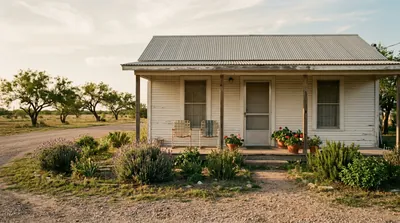
What the house smelled like
Lavender. Always. From the garden in summer, from sachets in winter, from the small bowl she kept on the table where she did her readings. Mixed with melted candle wax — she lit a votive every morning in front of the small altar to La Virgen de Guadalupe in her bedroom. Mixed with cinnamon, which she put in the coffee, in the rice, in the atole she made for sick neighbors.
I have never smelled anything since that smelled exactly like her house. Once, in a flower shop in Santa Fe twenty years ago, I caught half of it — the lavender and the candle wax — and I had to sit on the curb outside until I could breathe again. The cinnamon you only got if you went inside.
What her hands looked like
Small. Brown. Strong. The skin on the back of them had become, by the time I knew her well, the color and texture of old paper. Her fingernails were always clean and cut short. She wore one ring — a thin gold band she still kept on after my grandfather died in 1973. There was a small white scar across the second knuckle of her right hand from a sewing needle that had broken off in 1957. She told me about it once and laughed.
When she laid the cards, her hands moved slowly and exactly. There was no flourish. She turned each card the way you turn a page in a Bible — deliberate, attentive, letting it be what it was.
What she would not say
She would not say she was psychic. She rejected the word firmly. “Eso es palabra americana, mijo. Yo soy curandera. Sirvo al Señor.” That is an American word, my boy. I am a curandera. I serve the Lord.
She would not say she had a gift. She would say she had been given a particular kind of attention — “un modo de mirar”, a way of looking — and that the work was the work of training the looking, the way her sister had been trained to play the piano and the way her cousin had been trained to mend bones. The gift, she would say, was the looking. What the looking had to be trained on was something every woman in her line had been trained on for generations.
She would not say the chain was a private secret she had discovered. She would point at the verses underlined in pencil in her King James Bible — Exodus 20:5, Exodus 34:7, Deuteronomy 5:9, Numbers 14:18, Lamentations 5:7 — and she would say “esto está aquí desde antes de mí”. This has been here since before me.
She would not let me leave a reading at her side without saying, before the woman at the table left, that the redemption was bigger than the chain. She would point at Galatians 3:13 in her Bible and have me read it aloud. “Cristo nos rescató de la maldición de la ley.” Christ has redeemed us from the curse of the law. The chain is real, she would say, and Christ is bigger.
What she did say
She said “esto no es tuyo” more times than I could count. To the women at her table. To my mother, who wrestled with what her own mother had wrestled with. To me. To everyone who would listen and to many who would not.
She said “siéntate” — sit down — when someone tried to go too fast. She would have a woman sit at her kitchen table and drink an entire cup of water before she would let them speak about why they had come.
She said “escúchame” — listen to me — when she had something she wanted me to remember. She would put her finger on my forearm and tap it once, lightly, and say “escúchame, mijo”, and then she would tell me something I am still using forty years later.
She said “la cadena no termina sola” — the chain does not end on its own. Someone has to be willing to be the one in whom it ends. That phrase has become the spine of my entire adult life.
How she taught me
Slowly. By sitting next to her. She did not give me a textbook because she did not have one. She did not have a formal apprenticeship structure because the tradition does not have one. What she had was years.
I sat in on my first reading at fifteen. The neighbor was Doña Rosa, whose teenage son had been pulled in by the wrong crowd. My grandmother let me sit at the corner of the table where I could see her hands. She did not look at me. She did not introduce me. She did not explain afterward.
We did not talk about the reading at dinner that night. We talked about it three weeks later, when she was washing dishes and I was drying. She said one sentence: “¿Viste el primer portal?” Did you see the first gate? I said yes. She nodded once and we kept washing dishes.
This was how she taught. Not by lecturing. By placing me in the room and letting the room teach me.
The night she died
She was in her own bed. The hospice nurse had left for the evening. My mother was on one side of the bed and my aunt on the other. My uncle was in the hallway praying his rosary. I came into the room and she opened her eyes — they had been closed for most of the day — and she said “tráeme la baraja y la Biblia, mijo”. Bring me the deck and the Bible.
I brought them. I put them on her chest. She put her hand on top of mine and said the sentence I have repeated, in two languages, to thousands of souls since:
“Ahora la cadena pasa por ti. Tú decides si la rompes o si la pasas.”
Now the chain passes through you. You decide whether to break it or to let it walk.
She closed her eyes again. She lived another four hours. She did not speak again. She crossed at three in the morning, with her hand still on top of mine, with my mother’s head on her shoulder, with my aunt holding her other hand, with my uncle’s rosary still moving through the same beads it had counted every morning of his adult life.
I have been working through the next four hours, and the next forty years, ever since.
What she gave me
The deck. The Bible. The blue wool shawl. The leather crucifix. A handwritten letter on the dresser. A small bowl of dried lavender from her garden, sealed in a glass jar. The garden itself, which my mother kept alive, which my sister kept alive after her, which my niece now tends.
And the seeing. Whatever the right word is for the thing she could do at the table. She gave me the looking. She trained it from twelve years old until twenty-one. She did not finish. The training does not finish. I have been continuing it on my own for forty-one years and there are still afternoons when I sit at the table and I think “abuela, tu sabrías leer esto mejor que yo.” Abuela, you would read this better than I can.
She would not let me say that. She would say “sigue, mijo. Sigue. Es tu turno.” Keep going, my boy. Keep going. It is your turn.
Why I am writing this on a website
She would not have understood the website. She did not own a computer. She was buried before the internet existed for ordinary people. The phrase Spiritual Portal would have made her tilt her head and ask what kind of doorway I was talking about and whether I had remembered to leave a candle burning.
But I think — I am almost certain — that she would understand what I am trying to do. The descendants of the chain do not all live in the Rio Grande Valley. They live in Tampa and Tulsa and Akron and Phoenix. They live in Birmingham and Memphis and Charlotte. They cannot all come to a small wooden house in McAllen and sit at a kitchen table covered with a white linen cloth.
So the kitchen table has had to learn how to travel. The deck has had to learn how to be laid out at a distance. The blue shawl now sits, folded, beside the keyboard where I write to the souls who reach me from places my grandmother could not have located on a map.
What has not changed is the work. The seeing. The naming. “Niño, this is not yours. This came before you.” The first sentence she said to me in 1976. The last sentence I will say, God willing, before I close my own eyes.
The chain ends here.
— Celestino, May 2026, written in McAllen, Texas, on the seventh day of remembering