June 2, 2026
The Prayer to Saint Michael the Archangel
The full prayer to Saint Michael, the story of how Pope Leo XIII received it in 1886, what each line means, and how to pray it for protection over your home. Written by Celestino.
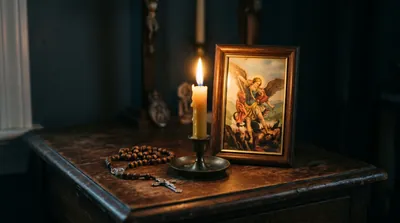
There is one prayer I have watched bring more steadiness to frightened souls than almost any other. It is short. It is old. And it is spoken, right now, by millions of people in a hundred languages every single day. It is the prayer to Saint Michael the Archangel.
Let me give you the words first, then tell you where they came from, then show you how to actually pray them — because a prayer you only read is a letter you never sent.
The prayer
Saint Michael the Archangel, defend us in battle. Be our defense against the wickedness and snares of the Devil. May God rebuke him, we humbly pray; and do thou, O Prince of the heavenly host, by the power of God, cast into hell Satan and all the evil spirits who prowl about the world seeking the ruin of souls. Amen.
Read it slowly. Notice something before we go further: at no point does this prayer ask Michael for anything by his own power. May God rebuke him. By the power of God. The whole prayer rises to God and asks Him to act through His archangel. This is the difference between Christian devotion and superstition, and I wrote about that line at length in what the Bible says about guardian angels. Hold it close. It keeps the prayer clean.
Where the prayer came from
The prayer is not ancient in the way people assume. It was given to the Church by Pope Leo XIII in 1886.
The story the Church carries is this: after celebrating Mass, the Pope is said to have stood as if frozen, ashen, having heard something — a vision, an exchange he would not fully describe — of the spiritual assault that lay ahead for the world. He went to his office and composed this prayer, and ordered it to be said at the end of every low Mass. For most of a century, Catholics across the world prayed it together, after Mass, in one voice.
The custom faded for a time in the twentieth century. But it has come roaring back in our own day. Whole dioceses across the United States have called their parishes to pray it again after Mass. Popes have urged the faithful to take it up once more. In a time that feels, to many ordinary people, more spiritually exposed than the one their parents knew, this old prayer has found a new generation reaching for it. I am not surprised. The soul knows when it needs a guard at the door.
What each line is really asking
“Defend us in battle.” The prayer assumes something most of modern life denies: that there is a battle at all. You already know there is. You have felt it — the pull against the good you are trying to do, the heaviness that descends for no reason, the door that stays shut. The prayer begins by telling the truth.
“Be our defense against the wickedness and snares of the Devil.” Not only against open wickedness, but against snares — the traps, the patterns, the things that catch a soul slowly. In my work I see these snares run in families, generation after generation. The prayer asks for defense against exactly that kind of slow, inherited catching.
“May God rebuke him, we humbly pray.” Humbly. We do not command the enemy ourselves. We ask God to rebuke him. This is Jude 9, where even Michael, contending with the devil, does not dare a railing accusation but says, “The Lord rebuke thee.” If the archangel speaks with that humility, so must we.
“Cast into hell… all the evil spirits who prowl about the world seeking the ruin of souls.” The prayer ends by naming the stakes plainly: the ruin of souls. Yours. The ones you love. It is a prayer for the protection of the whole house.
How to pray it
Do not overcomplicate this. My grandmother prayed at five-thirty every morning until the cancer would not let her kneel, and she never once made prayer into a technique. But here is what I tell the souls who ask me how to take this prayer up:
- Pray it daily, at a fixed time. The morning, before the day’s noise. Or the night, as you close the house. Fixed time matters more than fixed words — it builds the habit the soul leans on when fear comes suddenly.
- Pray it over your house, not only yourself. Stand at the door if you like. Ask God’s protection over everyone who sleeps under that roof. Scripture sends an angel before whole households (Exodus 23:20).
- Pray it slowly enough to mean it. A rushed prayer is a wish. A meant prayer is an act of faith. Let each line land.
- Keep a sign of it near you. This is older than you think.
On keeping a sign near you
My grandmother wore a small silver crucifix on a worn leather cord every day of her life. It held no power of its own — she would have been the first to say so, sharply. It was a reminder, worn against the skin, of the One she was praying to and the protection she was asking for. When her hand brushed it during the day, the prayer returned to her without words.
Many souls who walk with me keep a Seal of Saint Michael the same way — a small, blessed sign of the protection they are asking God for over their home. It is not a charm. It does not work like a spell, and anyone who sells it to you as one is leading you off Christian ground. It is what my grandmother’s crucifix was: a reminder, worn close, that the prayer is being prayed and the door is being guarded.
If you want to understand why it is Michael, of all the angels, that the Church reaches for in the hour of fear, read why Michael stands against the chain.
“The chain ends here.”
Pray the prayer tonight. Pray it slowly. Pray it over everyone asleep in your house. And know, as you say Amen, that you are joining millions of voices that have said these same words before you — and the God they rise to has been listening the whole time.